Mr. Bango’s Story
Mr. Bango, a US military veteran, came to prison later in life. “I came home from combat with physical [and] psychological injuries…Unfortunately, the pain meds I was given masked the pain that was going on psychologically. After they turned the spigot of opiates off, then [I] started shopping them on the streets. All of that involves bad choices, bad company, bad decisions…the whole myriad of things that are a highway to prison…” A spiral of substance use and interpersonal harm resulted in Mr. Bango’s over 20-year sentence in prison.
“The 20 years before I went to prison, I lived what most people would say is a normal, even an admirable life. I have four children and a spouse. When I was in the army, I was a non-commissioned officer. But in prison you’re just a number. All of these awards, accolades, accomplishments, all those things are stripped away. Almost immediately. This is a culture shock.” When he arrived at prison, Mr. Bango knew that with resources, tools, and coaching he and others would have a better chance of success when they returned to the community.
Amend’s Intervention
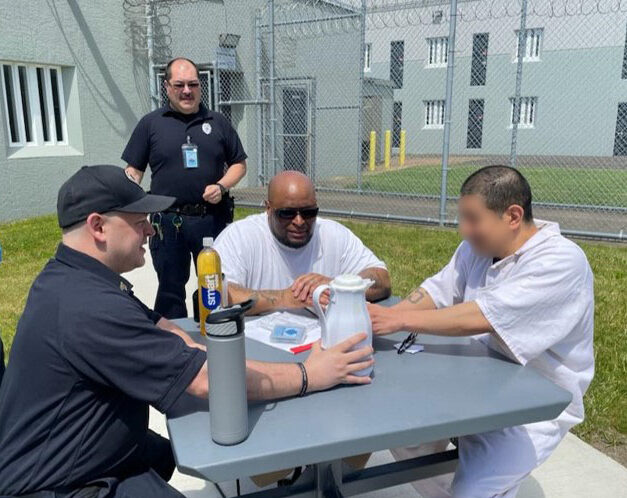
Seeking out opportunities to make up for his actions, Mr. Bango was introduced to the prison’s Resource Team, a specialized, interdisciplinary group of prison staff and peer mentors that works with high-risk, high-need people in long-term solitary confinement. Mr. Bango was inspired by the Resource Team’s approach to supporting those in solitary confinement and helping them transition to more traditional prison living units. As a peer mentor, Mr. Bango played a critical role by putting clients at ease in the presence of officers.
Peer mentors are integrated onto the Resource Team as core team members who are trusted cultural translators between the client and prison staff. They perform a highly-specialized function — encouraging the person in solitary confinement to engage with the Resource Team, answering their questions, and helping reach the goal of transitioning them out of isolation through participation in meaningful, structured activities out of their cell. Over time, the peer mentor is often able to help the individual in solitary confinement build trust with the Resource Team officers.
I think this opportunity has done more for me than other things in life I’ve done…I would change everything about going to prison except for this part. This has been very rewarding…I didn’t see this coming. – Mr. Bango
“Each and every individual is remarkable…The first guy had been in solitary confinement for over 13 years…He turned out to be an intelligent, thoughtful, and just a regular guy…He knew there were people behind him that looked up to him…and if he came and believed in it and saw it for what it was, then the people behind him would too.”
The Outcomes
The Resource Team has had a profound impact on people who are incarcerated in long-term isolation, staff, and peer mentors, like Mr. Bango. “You see them let their shoulders relax over the period of weeks. And then the restraints come off. And they’re looking at you like, ‘I can walk over there and get a cup of coffee?’ They’re not wearing the same face that they walked into the room with, even when they’re having a challenging day.” Mr. Bango also described a similar transformation among staff on the Resource Team. “I see the impact it has on the staff…They smile, they laugh. It looks like they enjoy what they’re doing. They come in here motivated…When you’re seeing that you’re making a positive impact, you’re that much more motivated to come to work. You see the fruits of your labor, day in and day out.”
What’s Next
Amend aims to inspire, teach, and collaborate with prisons to reduce harm and create safer, healthier, and more supportive environments. The Resource Team and Mr. Bango’s experiences show that it is possible to immediately reduce harm in carceral environments, particularly in areas of profound isolation, that there is a critical role for peer mentors in helping to reduce the use of solitary confinement in prisons, and that safety and security can coexist — and even improve — with enhanced humanity and compassion.